About a home that you can leave but that you can't always leave
Dom nadal czeka.
Dzieci dawno dorosły —
drzwi są wciąż otwarte.
A house doesn't have to be haunted by ghosts
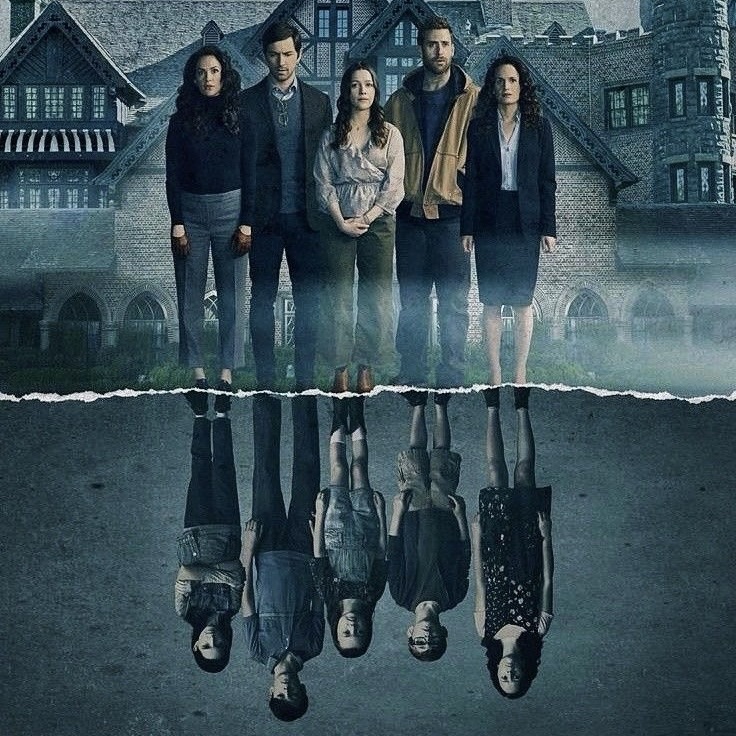
Series Haunted house on the hill (The Haunting of Hill House, 2018) by Mike Flanagan, inspired by Shirley Jackson's 1959 novel, takes from the literary prototype Hill House, its atmosphere and the idea of a place that affects people, but builds a completely new story out of them.
The history of the Crain family.
Hugh and Olivia move with their five children to an old house, which they intend to renovate, sell and thus build their dream "forever house". The stay was supposed to be just an episode.
It turns out to be an event that will define their entire later life.
Flanagan leads the story in parallel in two times. We see the children in Hill House and the same people many years later. Adults who have seemingly left home a long time ago, and yet each of them still lives in it in some way.
Steven tries to explain everything.
Shirley controlled.
Theo don't let others get too close.
Luke escapes.
Nell searches for answers.
Each of them found their own way of dealing with something that they could neither understand nor name as a child.
And right here The Haunting of Hill House for me it ceases to be a story about a haunted house.
It becomes a story about trauma.
About family.
About mourning.
About memory.
About what happens to a child when something too big happens to hold — and what the adult that child has become does later.
Flanagan's ghosts are terrifying.
But the most important of them do not stand in dark corridors.
They go with the characters throughout their lives.
Paweł: Five children, five ways to deal with the same pain
Wounds from childhood, although scarred and sometimes even forgotten, with the passage of years reverberate from time to time, remind us of events that we try not to remember. And moments of weakness make pain and fear come back.
What used to be scary continues to haunt and lurks in various places, suddenly appears in unexpected situations. Each of us deals with it differently. We defend ourselves in our own way. But often it is an illusion, an individual safe room in the head is a seemingly safe space.
Facing the truth and accepting it is the only way to live in the real, real world, where suffering is always present, and not in reality, which is an illusion that alleviates anguish.
To stop running away – paradoxically, this is a real way out of a house full of demons of the past.
Agnieszka: Nell scares me the most
I could write about the architecture of Hill House. About the ghosts hidden in the frames. About the Red Room. About how brilliantly Flanagan manipulates time and memory.
But when I think about this show, I think back to Nell in the first place.
And to the Woman with the Broken Neck.
Because there is something terribly sad in this idea.
For years, Nell has been afraid of the apparition that appears in the worst moments of her life. She sees it as something strange. Something that haunts her. A threat coming from the outside.
Only later do we discover that she was looking at herself all the time.
I don't want to reduce it only to a spectacular time paradox.
For me, this is one of the strongest metaphors of the entire series.
Sometimes for years we run away from something whose source we look for everywhere but ourselves.
Not because we are blind.
Because we don't yet have a perspective that allows us to see the whole.
As a person on the spectrum, I know very well the experience of reconstructing my own past with knowledge that I did not have before. Going back to the situation and suddenly understanding: So that's why.
That's why something was so difficult.
That's why I reacted differently.
That's why I couldn't do what seemed obvious to others.
It does not change the past.
However, she changes the person who looks at her.
And I guess that's why the Red Room has such an effect on me.
Each of the children sees it differently. For everyone, it becomes a space that meets their needs. A safe place that is not safe at all.
This is an extremely apt metaphor for our protective mechanisms.
We don't always recognize a cage as a cage.
Especially if it is arranged exactly in such a way that we want to stay in it.
And then there's the house.
Hill House.
A place that should provide security, but gradually takes away the family's ability to recognize what is real.
And here I come back to something that appears in many of the films we write about in Dark cinema.
The house is one of the most primal symbols of security.
That is why horror so often takes it away from us.
If the monster is in the forest, you can lock the door.
If he is on the street, you can go home.
But what to do when the threat is already inside?
Maybe that's why The Haunting of Hill House is much sadder than terrible for me.
Because in the end, it is not about people trying to defeat ghosts.
It tells the story of adult children trying to understand what happened to their family.
And about the fact that you can move hundreds of kilometers away, build a new life, find a job, start a family, learn to function.
And yet they still sometimes wake up in Hill House.
We leave some houses.
We have to come out of others throughout our lives.

Dodaj komentarz