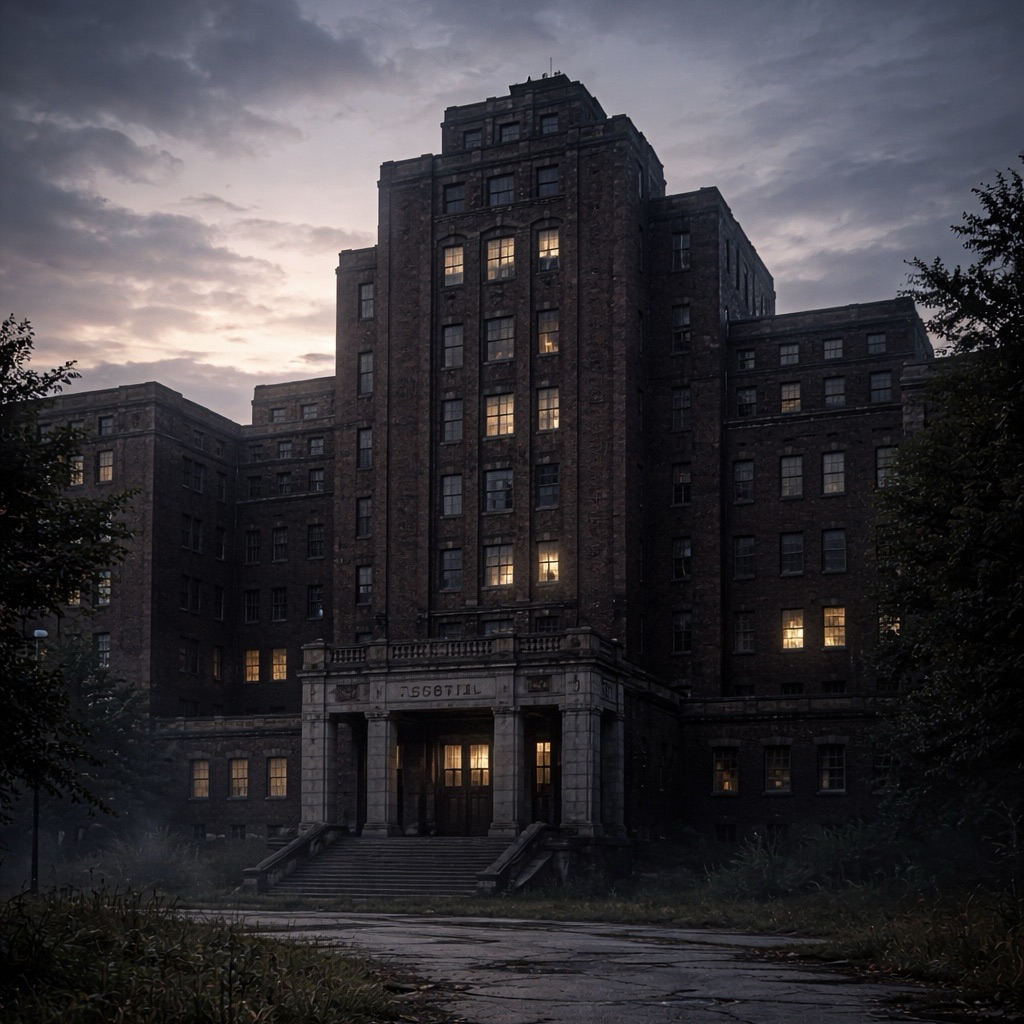
About the place where the cracks are louder than the diagnoses
Szpital oddycha.
Pod podłogą coś czeka.
Śmiech ma smak strachu.
A hospital that is never just a hospital
Riget (The Kingdom) is a 1994 Danish drama series by Lars von Trier, set in Copenhagen's Rigshospitalet — a place that, by definition, is supposed to heal, organize and restore control.
In von Trier's case, this control does not exist.
The hospital becomes an organism: full of mysteries, ghosts, anxieties and cracks between what is rational and what is repressed. Medicine collides with metaphysics, science with superstition, and professional distance with pure human fear.
Riget balances between horror, grotesque and black humour — not to scare directly, but to undermine faith in the order of the world, which pretends to be stable only on the surface.
Paweł: Silence that collects what has been displaced
Not everything you hear belongs to the present. Evil can be firmly rooted in history and affect who you are now, it can hold you by the neck. And it doesn't let go. Listen to the silence between words, but be careful what you hear. Because what are the limits of rationality? You're afraid, words get stuck in your throat when demons besiege you. But you can also try to tame them. Look for harmony in this chaos.
The line of control is thin. It's an illusion. Rationality is in retreat here, everything has its own procedure. But procedures don't include the inexplicable. Because the norm is just an agreement. Change can throw you off balance, it doesn't fit into the plan. What is most worrying is what doesn't fit into the norm. Because not everything is contained in the scheme.
The body is a place where fear and mystery gather. It remembers, even when the head denies. And not everything can be fixed. Try to save what you can in yourself to survive. The grotesque says more than seriousness. Laughter exposes what we are afraid to name. You can save as much of yourself as possible.
Agnieszka: When I go back to something that is already left in me
I watched Riget a long time ago. I don't come back to it with frames or scenes — I come back with the impression that has been left in my body. Now I see this series differently, because I see myself differently. As a person on the spectrum, I read it not as a story, but as an experience of overload, anxiety and cracks that are never accidental.
For me, the hospital in Riget is not a place of horror in the classical sense. It is a space in which stimuli do not form a coherent whole. Sounds, images, tensions — everything is slightly shifted, as if the world is half a tone too loud and a step too close. I know this feeling all too well.
Today, I see in this series a story about how the system tries to cover up chaos with a procedure. How "normality" can be a tool for displacing what is uncomfortable, illegible, too intense. And people who feel differently, see more or react more strongly are pushed to the margins — considered a problem, not a signal.
Riget does not give an answer. And maybe that's why he returns after years with new strength. Because from the perspective of people on the fracture spectrum, they are not the fault of the system — they are the only place through which you can see the truth.

Dodaj komentarz