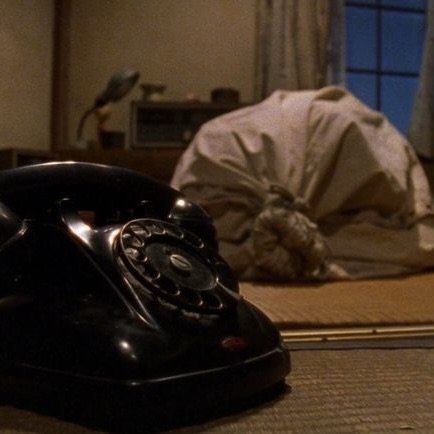
About the fact that it's easiest to fall in love with your own imagination
Uśmiech jak cisza.
Miłość nie zna imienia —
igła pamięta.
About the man we never really met
Audition (1999) Takashi Miike is remembered by many as one of the most shocking horror films of the late twentieth century. But its strength does not lie in its brutality.
For most of the film, we watch a calm drama.
Aoyama's widower, persuaded by a friend, organizes a fictitious casting for a film role. In fact, he is looking for a woman with whom he would like to build a new relationship.
Among the many candidates, Asami appears.
Quiet.
Delicate.
Ideal.
At least that's what it seems at first.
Takashi Miike guides the viewer very carefully. At first, he allows us to believe that we are watching a story about loneliness and a second chance. Only later does he show that from the beginning we were looking not at a person, but at an image of him.
Audition is not a film about revenge.
It is also not a film about violence.
It is a story about the illusions we create about another person. About masks, expectations and loneliness, which can turn another person into a project of one's own desires.
The most dangerous thing turns out to be not who someone is.
The most dangerous thing is who we want to see him with.
Paweł: When you fall in love with history
Every story begins innocently: with one question, one decision and the belief that everything is under control. Some people appear quietly, without big words, but they change the direction of the whole story from the beginning. The most mysterious of them don't tell much about themselves. They leave room for our own imaginations, and that's where illusions are born. Is everything as it seems, or do we want to see what is comfortable for us? What we see very rarely is the whole truth. People show the world only selected fragments of themselves. Not everything is unambiguous. Beneath the surface there is chaos and unpredictability.
The line between fascination and obsession is much thinner than we would like to believe. What changes us the most is the moment when we understand that reality looks different than we thought all along. Pain can be a path of expressing feelings, the sense of security can be false. It is then difficult to open up to love. Mutual dependence is a loop with no way out.
Every choice has consequences, not always immediately, but sooner or later there comes a moment when you have to meet them. Obsession, manipulation and lust are a game of violence. It's the perfect recipe for a bad ending...
Agnieszka: Masks that we don't notice
I'm looking at Audition First of all, for a film about screenings.
About how much we want to believe, that we can recognize another person after a few encounters. That silence means gentleness. That kindness means safety. That our first impression is true.
From the perspective of a person on the spectrum, this film moves me for another reason.
I've been hearing about autistic masking for a long time. About how people on the spectrum learn the behaviors that the world expects of them.
Audition shows the opposite.
It's not just people who put on masks.
We also apply them to others.
We build an image of the other person from our own expectations, desires and fears. We stop seeing a person. We start to see the role they are supposed to play in our lives.
And that's why this film seems so disturbing to me.
Not because it shows violence.
Because it reminds us how easy it is to confuse one's own imagination with reality.
How often do we fall in love not with a person, but with a version of him created by ourselves.
And when the masks fall, it turns out that the real encounter is just beginning.
Maybe that's why it's worth looking more closely.
Not to judge faster.
To really see.

Dodaj komentarz